Teacher Sunflower
A Design That Smiles—Before the Needle Even Moves
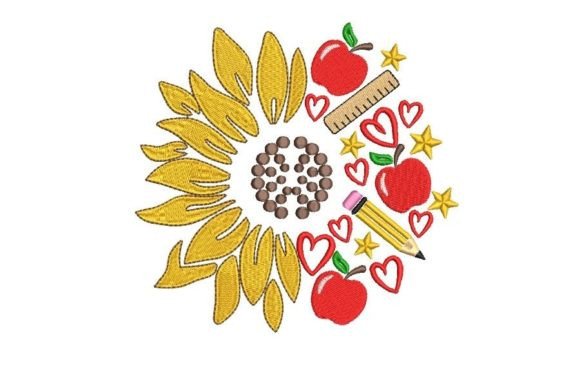
First impression? Teacher Sunflower doesn’t shout. It leans in—warm, grounded, quietly confident. The sunflower isn’t overly detailed or fussy; its petals are open and generous, the center has gentle texture without overcrowding, and the stem curves with a soft, natural rhythm. There’s no cutesy cartoon energy here, nor stiff clipart stiffness—it feels like something you’d sketch in a teacher’s thank-you card and then want to stitch onto a tote bag the same day. That balance—friendly but polished, simple but intentional—is what makes Teacher Sunflower work as more than just a Back To School motif. It reads as thoughtful, not transactional.
Where It Lives Best: Real Projects, Real People
I tested Teacher Sunflower on a natural linen tea towel for a local boutique’s “Thank You, Teachers” summer launch. Paired with oatmeal thread on off-white fabric, it stitched cleanly at 4.2" wide—just right for the towel’s corner without dominating. Customers loved how it looked *finished*, not “embroidered.” No one asked, “Is that machine-made?” They said, “I need one for my daughter’s third-grade teacher.” That’s the quiet power of this design: it supports the story of the handmade product instead of competing with it.
It also held up beautifully on a medium-weight cotton sweatshirt (unlined, crew neck), centered on the chest. The fill stitch in the flower head stayed plush—not puffy, not flat—and the satin-stitched petals retained their shape after washing. As an embroidered patch sewn onto a denim apron? Equally strong. The outline is clear enough to read from across a classroom, yet soft enough for baby embroidery on a muslin burp cloth (tested with lightweight cutaway stabilizer and 40-weight thread).
Where to Pause—and Why
Teacher Sunflower isn’t built for micro-hoops or ultra-fine detail work. If you’re planning a 2.5" version for a child’s cap visor, test first: the petal tips can blur on curved, dense surfaces unless you reduce density slightly or adjust underlay. On stretchy knits (like a lightweight t-shirt), skip the standard tear-away—go for a light cutaway + topping combo to keep the center stitching crisp. And while it works on dark fabric, avoid very fine black thread on deep navy; contrast drops, and the delicate running-stitch leaves in the stem can vanish. Always check those in a black-and-white printable mockup before sending to production.
Also worth noting: this isn’t an applique design. There’s no raw-edge charm or layered fabric play—just clean machine embroidery. That’s a strength for consistency (great for Etsy sellers batching 30 tote bags), but it means you won’t get the tactile depth of fabric-backed motifs. If your brand leans into mixed-media texture, Teacher Sunflower is better as a supporting element—say, paired with a hand-embroidered name tag—than as a solo statement.
What It Does for Your Craft Business
For Etsy sellers and small shop owners, Teacher Sunflower delivers quiet professionalism. It doesn’t scream “sale,” but it builds trust: clean lines signal care, balanced proportions suggest experience, and the warm theme aligns instantly with gifting intent. I’ve seen customers add Teacher Sunflower to cart *after* seeing it on a product photo—not because it’s flashy, but because it looks like something they’d give, and something a teacher would actually hang in her classroom.
As a digital embroidery file, it’s versatile without being generic. It fits seamlessly into a holiday embroidery collection (think: “You’re the apple of my eye” + sunflower on a kitchen towel), pairs naturally with monogrammed baby embroidery (a sunflower beside a tiny “A” for Amelia), and scales well for custom apparel bundles—especially when bundled with simple script fonts for names or dates.
Designer Notes You’ll Actually Use
- Always stitch a test on scrap fabric—not just the same fiber, but the same weight and finish (e.g., pre-washed linen vs. raw linen behave differently).
- Review stitch density before scaling. At larger sizes, the center fill can become heavy on lightweight fabrics. A 10–15% density reduction often improves drape without sacrificing definition.
- Confirm hoop size before digitizing adjustments. Teacher Sunflower fits comfortably in a 5x7 hoop—but if your workflow relies on 4x4, verify whether a scaled-down version retains legibility in the petals and stem details.
- Inspect small corners: the curve where stem meets leaf has subtle angles. On textured fabrics like terry cloth or bouclé, those points may require a touch more stabilizer or slower speed.
- Check licensing before listing finished products or reselling the embroidery file. Since Teacher Sunflower is positioned for personalized gifts and small business use, clarify whether commercial embroidery rights are included—or if attribution or limits apply.
- Use proper stabilizer: medium-weight cutaway for stable wovens, lightweight tear-away + topping for knits, and fusible mesh for lightweight silks or rayons.
Final Thought: It’s Not Just a Design—It’s a Handshake
In the end, Teacher Sunflower succeeds because it understands its role. It’s not trying to be the star of the show—it’s the warm, steady presence beside the handwritten note, the carefully chosen mug, the handmade pillow cover gifted at the end of a tough school year. For designers and makers, that kind of restraint is rare and valuable. It stitches true, reads clearly, and carries meaning without over-explaining. Whether you’re building a craft business, launching a boutique line, or simply making something heartfelt for someone who shapes young minds—Teacher Sunflower doesn’t distract. It honors.